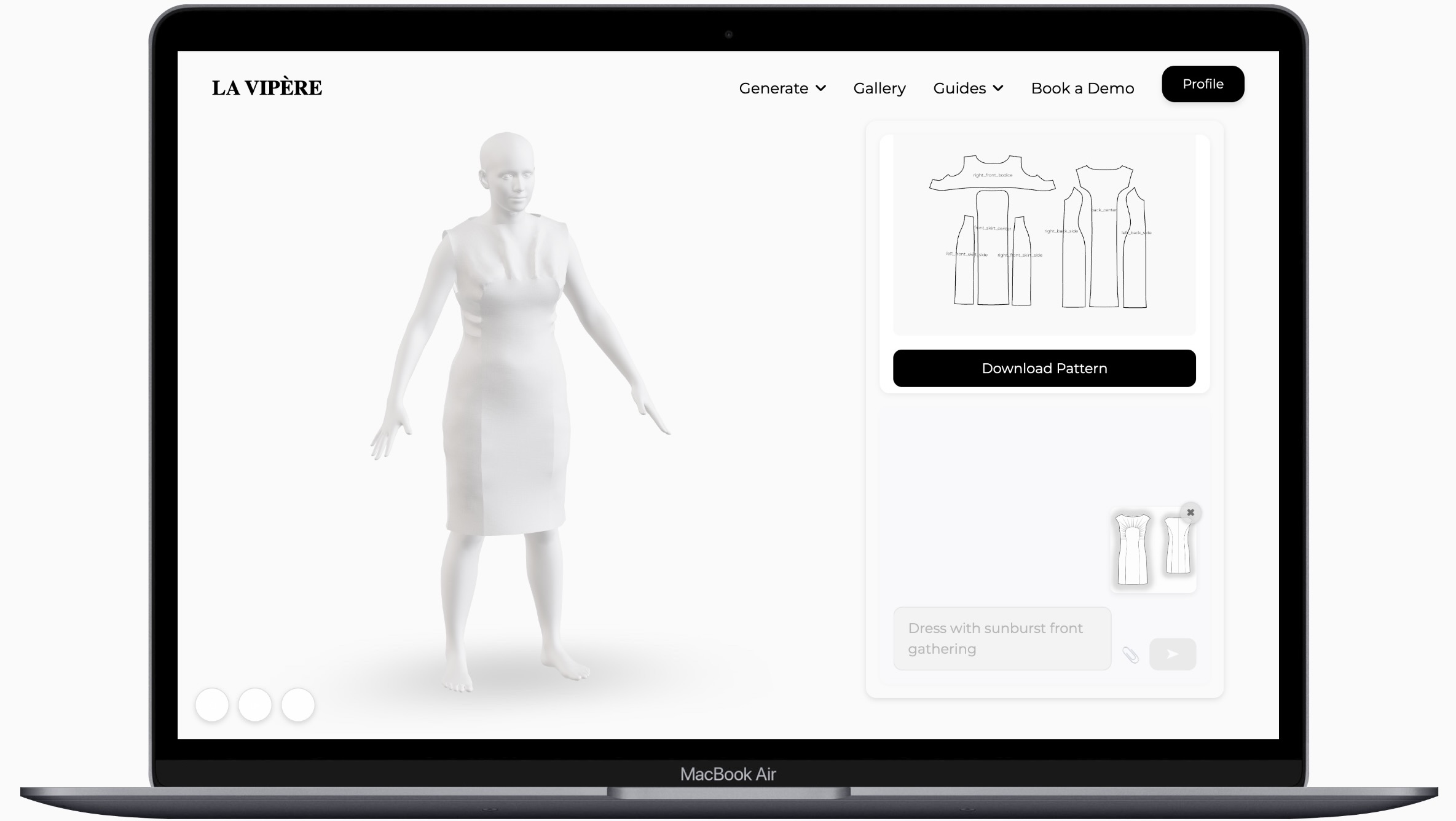
I am not a professional pattern maker. I learned because I wanted clothes that fit my body and my taste. For me, CLO3D was a pattern-making tool: layout, iteration, and sanity checks before I bought fabric. I did not treat it as backdrop for a pretty render.
It sped up how I learned and let me build patterns that matched my vision. I could go from simulation to cutting real cloth with confidence, usually without an extra sampling loop, and I got fits I actually wore. When I look at how most of the industry runs 3D today, late and thin, next to where the real pattern work happens, that gap feels like a giant missed opportunity. I believe AI is what finally pulls 3D into construction, ties it to grading, markers, materials, and fit, and fixes the workflow we have normalized. The rest of this note is what I have seen up close, and what we are building toward.
What I saw when I entered the industry
I expected 3D to live in construction, next to the pattern. Instead I found it used late, as visualization and a final check. The pattern is still too often an afterthought: the garment gets decided in one lane, and the engineering catches up later.
It is the same old split you see elsewhere: design in one building, engineering in another. Very few companies really mix the two. People always bring up SpaceX as the counterexample, and those teams move at speeds that are hard to square with a handoff-heavy apparel calendar.
What people told me when I asked why 3D never owned construction
I was curious, so I talked to a lot of people across the industry. There was no single villain. I heard a stack of honest reasons:
- The tools. Many 3D products are strong on look development and weak on the pattern making and grading depth you need for production.
- Time. If the digital path is not the same path to the cutter, building in 3D can feel slower than going straight to another physical sample.
- Training and incentives. Teams get rewarded for shipping seasonal assets and decks, not for simulation quality or construction rigor up front.
- Data in silos. Fabric cards, BOMs, consumption estimates, and fit notes rarely live in one place you can iterate on as a single object. The learning dies at every handoff.
How I think about what we're building
My approach with LA VIPÈRE is blunt: the pattern is the center of the universe. I get there by forcing design, pattern making, marker, material, and grading into one step. If those stay separate pipelines, you do not unlock real AI in any meaningful sense. You add another icon to an already fragmented stack.
When design, the pattern, grading, marker, and fabric all live in the same loop, a change is a real change. You see what it does to the pieces, the yardage, the fit on the body, and the way the cloth behaves, not weeks later in someone else's inbox. That is what makes AI useful here: it can try lots of versions because every variant is tied to real measurements.
Where I believe 3D has to live
I believe 3D has to move to center stage in construction and become genuinely data-rich: fabric behavior, consumption, strain and drape, fit feedback you can count. That is what gives AI a feedback loop. It needs room to explore billions of design parameters and learn what good construction looks like for a whole line, not for one polished still.
I am not pretending today's tooling is finished. For this to feel normal in production, 3D still needs more investment on accuracy and speed. We can aim for the loop and stay honest about the gaps.
Where I want AI to go next
The direction that matters to me is not another slick image. It is software that both constructs the base pattern and pushes the geometry toward better fit and better material efficiency at the same time. Two goals, one coupled problem. That is hard to fake if design, markers, textiles, and grading still live in different tools that never agree.