The term "AI Native CAD" gets thrown around a lot in fashion tech. But what does it actually mean? And why does it matter?
Most tools calling themselves "AI pattern making" are block-based recombination systems. They remix archived sleeves, collars, and silhouettes from a library. That works when you want to repeat what you have already done. It fails when you need something that has never existed before.
True AI Native CAD is different. It reasons from first principles of geometry, construction, and drafting logic. It can create silhouettes that did not previously exist, respect measurement constraints as hard mathematical conditions, and preserve brand DNA without being locked to rigid templates. That is what AI Native CAD actually means.
And LA VIPÈRE is fashion's first platform built this way from the ground up.
What Is AI Native CAD?
AI Native CAD is a system that generates patterns by reasoning from first principles of geometry, construction logic, and drafting rules—not by recombining existing pattern blocks from a library.
The Problem with Block-Based Systems
Most "AI pattern making" tools on the market today are block-based recombination systems. They work like this:
- They maintain a library of archived sleeves, collars, bodices, and silhouettes
- When you request a new pattern, they search the library for similar pieces
- They remix and resize those existing blocks to match your measurements
- If your design does not exist in the library, the system fails or requires heavy manual cleanup
This approach works when you want to repeat what you have already done. It fails when you need something novel—an asymmetrical construction, an unfamiliar silhouette, or a non-standard seaming pattern that has no historical precedent in the archive.
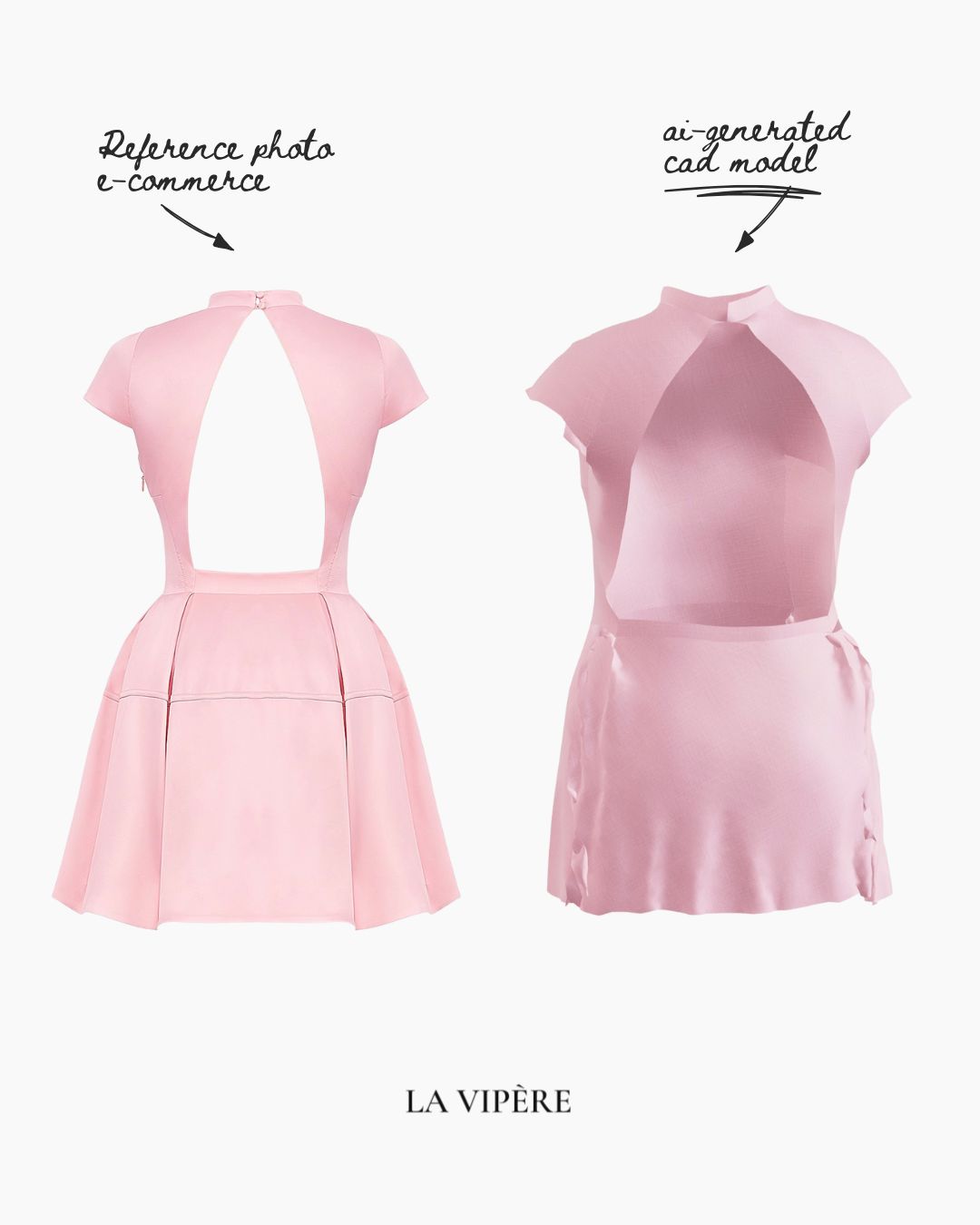
Reference photo to AI-generated CAD model: LA VIPÈRE drafts from geometry, not from a library.
What True AI Native CAD Does
True AI Native CAD reasons from first principles:
Geometric Logic
It understands that a sleeve must fit an armhole because the geometry demands it. Every notch, grainline, and seam allowance is calculated with mathematical certainty, not statistical guessing.
Construction Rules
It learns drafting relationships and proportional logic. It knows how to construct a raglan sleeve, a set-in sleeve, or a dolman sleeve from the underlying geometry, not from a template.
This means it can create silhouettes that did not previously exist, respect measurement constraints as hard mathematical conditions, and preserve brand DNA without being locked to rigid templates. The system thinks beyond the archive.
Why LA VIPÈRE Is Fashion's First AI Native CAD
When I started building LA VIPÈRE, I was a computer scientist and mathematician who had just bought a sewing machine. I thought: how difficult can pattern making be? Humans have made clothes since forever. We must have solved all of these problems by now.
Then I opened my first pattern making book.
I could not believe that this is still how clothes are made. There was no real engineering framework. The process was entirely manual, fragile, and dependent on individual expertise built over decades. I accepted it, learned the craft, started using 3D simulation from day one, and spent two weeks on a single pattern while my brain melted trying to move segments and points around a screen.
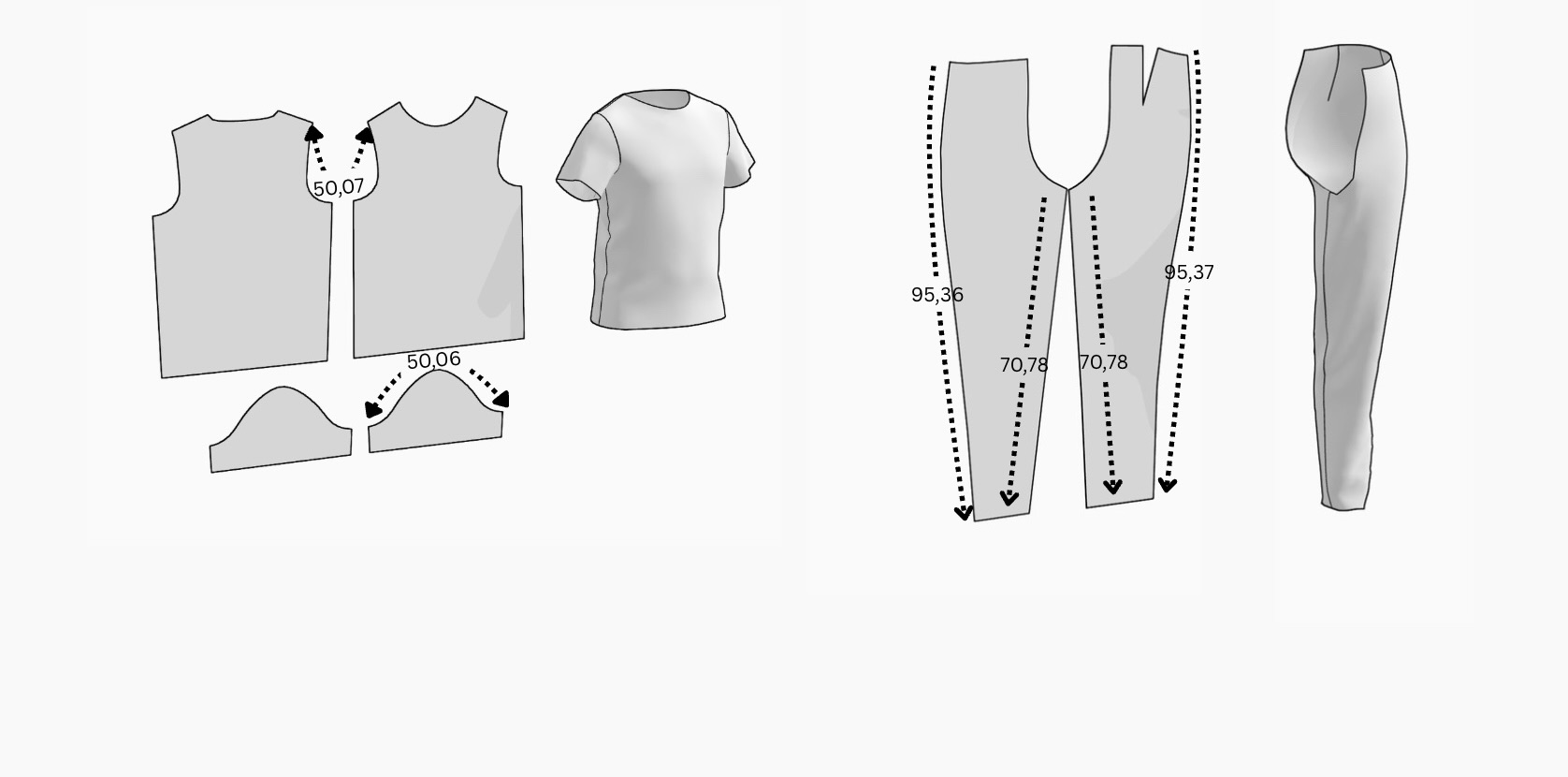
Every seam matches to the millimeter. The geometry demands it.
I quit my job and started solving this from first principles. Because our system is built on algorithmic drafting rules, it calculates every notch, grainline, and seam allowance with mathematical certainty. This is not statistical guessing. This is computational geometry.
Built on Computational Geometry, Not Statistics
Most AI systems in fashion rely on pattern recognition and statistical learning. They look at thousands of existing patterns and learn to predict what a new pattern should look like based on similarity. That is why they fail on novelty: they can only produce variations of what they have seen.
LA VIPÈRE is built differently. Instead of learning from patterns, it learns the underlying rules of pattern making:
- How to construct a sleeve cap that matches an armhole curve
- How to distribute ease across a garment proportionally
- How to true seams so they align perfectly when sewn
- How to respect measurement constraints as hard mathematical conditions
This is why LA VIPÈRE can generate patterns for designs that have never existed before. It does not need to have seen a similar design in a library. It reasons from the geometry.
Brand DNA as a Geometric Constraint
When a brand sends a measurement chart to a factory, that chart becomes a hard mathematical condition in our system, not a suggestion. We preserve the brand's unique fit identity while giving the factory the freedom to generate entirely new, complex silhouettes that have no historical archive.
"It's fresh air into the business. It's something that the industry needs to shift into. We will definitely use something like this. Talent and experience tends to become scarce. We really need an extra hand."Factory owner producing for Europe's notable brands
I showed this to a factory owner who produces for some of Europe's most notable streetwear and fashion brands. His team of three pattern makers handles 200 requests a week. When he saw what LA VIPÈRE does, he called it "fresh air into the business."
His team deals in novelty and complexity every single day. They receive requests for designs that have no historical precedent. A block-based system cannot help them. A system that reasons from first principles of construction turns every brief into an opportunity instead of a bottleneck.
Why This Matters: The Difference AI Native CAD Makes
The factory owner I spoke with described the problem clearly. His team of three pattern makers handles 200 requests a week. On a good day, each pattern maker handles 15 to 18 styles. On a difficult day with complex constructions, that number drops to three or four.
Last week alone, his team received 200 pattern requests. One single client launched 40 styles in a single day, all needing to be patterned from scratch just for pricing. The demand cycles have become completely unpredictable. Some days are overwhelming, others are nearly empty. Hiring more people is not sustainable when the workload swings that hard.
This is not an edge case. This is the new reality of apparel manufacturing. And most "AI tools" on the market cannot solve it because they are built on block-based recombination. They fail on novelty.
What AI Native CAD Enables
Handle Novelty at Scale
When a factory receives 200 novel requests a week, many with no historical precedent, a block-based system cannot help. AI Native CAD reasons from geometry, so it can handle designs that have never existed before.
Scale Without Additional Headcount
AI Native CAD enables a factory to take on more styles, more complexity, and more clients without hiring additional pattern makers. The AI handles the drafting logic. Your team focuses on quality control.
The factory owner described his vision: for simpler styles, an account manager could upload the measurement chart and design image, prompt the platform, and export directly to cutting software. For complex styles, the pattern maker validates the output. But the first prototype is already done by the platform.
"If a first proto is done by the platform, it's already amazing," he told me. Today, a complex multi-component pattern can take an experienced maker an entire day. If the platform delivers even a solid shell with all measurements matching and seams trued, the time saved per style is measured in hours, not minutes.
AI Native CAD is not about rearranging existing blocks or playing with probabilities. It is about reasoning from first principles of geometry, construction, and drafting logic. It is about creating patterns for designs that have never existed before.
LA VIPÈRE is fashion's first AI Native CAD platform because it was built this way from the ground up. Every notch, grainline, and seam allowance is calculated with mathematical certainty. Every pattern respects measurement constraints as hard conditions. Every design can be novel, because the system reasons from geometry, not from a library.
The industry is moving fast. Brands are demanding Zara-level speed from every supplier. Talent is getting scarce. And the tools that promised to help have mostly been rearranging existing blocks. What manufacturers need is a system that can think beyond the archive.
That is what AI Native CAD means. That is what LA VIPÈRE is. And that is why it is fashion's first.