Prompt Guide

Master the art of writing effective prompts for AI-generated designs

LA VIPÈRE generates patterns from scratch using detailed prompts with exact measurements. Write effective prompts with precise measurements and construction details to generate complex patterns with mathematical accuracy. The AI understands technical garment descriptions and can bring your detailed design specifications to life. Generate patterns from images or text prompts - no manual pattern drafting required.

What Makes a Great Prompt?

A well-crafted prompt with precise measurements and construction details is the key to getting exactly what you envision. LA VIPÈRE's AI understands technical garment descriptions and can bring your detailed design specifications to life. Specify exact measurements through detailed prompts for mathematically accurate pattern generation.

Prompt Structure

1. General Overview

Start with the basic garment type and overall style

Example: "A mini dress with cap sleeves, an open back, a turtle neck and a pleated skirt."

2. Panel Summary

Describe how many panels the garment contains and their general positioning

Example: "The dress features a fitted top which is split into a centre front and side panels. The cutlines meet at the bust apex."

3. Specific Construction

Add detailed construction with precise measurements

Example: "The first cut line starts at 4cm below the underarm and runs until the bust apex. The second cutline is curved, starting at the bust apex, through the underbust then to the waist."

4. Technical Details

Specify precise measurements and alignment

Examples: "cap sleeves having endpoints 4 cm to the sides of the underarm", "neck band of about 2.5 cm", "single box pleat aligned with the upper vertical cut seam"

5. Colors & Patterns

Specify colors and patterns

Examples: "navy blue", "floral print", "monochrome", "pastel pink"

6. Fabric & Texture

Describe materials and textures

Examples: "silk chiffon", "structured wool", "flowing jersey", "textured tweed"

Real Design Examples

Complex Bustier Dress with Gathered Side Skirt
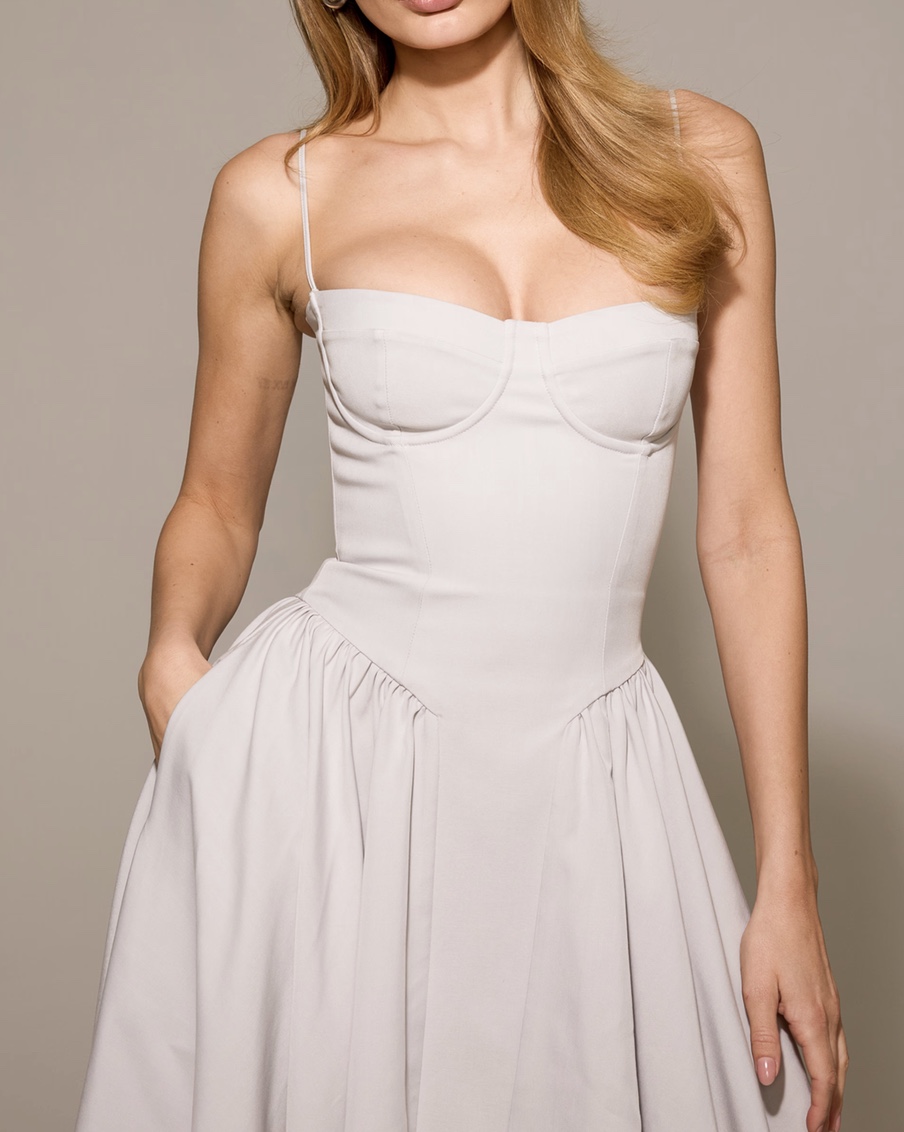
Samaria Dress
"A calf-level dress with bra cups, princess seams and side skirts with top gathers. The dress features three panelled bra cups featuring a horizontal panel and two bottom panels split at the bust apex line. The bra cups are supported by princess seams stopping at an inserted skirt. The inserted skirt features a top curve starting 5cm away from the centre front and at the hip level and curving up to meet the side seam at 4cm below the waist level, continuing to the back to curve to the bottom again similar to the front. The curve is delimited by two straight vertical seams running to the dresses' hem. The side skirt upper curve is gathered to provide volume and the entire hem curve is flared. The front features a center front panel, two side panels, two side skirts and two bra cups with three panels each. The back features two centre back panels split in the middle by the center back seam for zipper insertion, two side panels and two side skirts. The side skirts form the front and back are merged together."
Complex construction with detailed panel breakdown, precise measurements, and technical construction elements including bra cup engineering and gathered skirt insertion.

Mini Dress with Open Back and Pleated Skirt
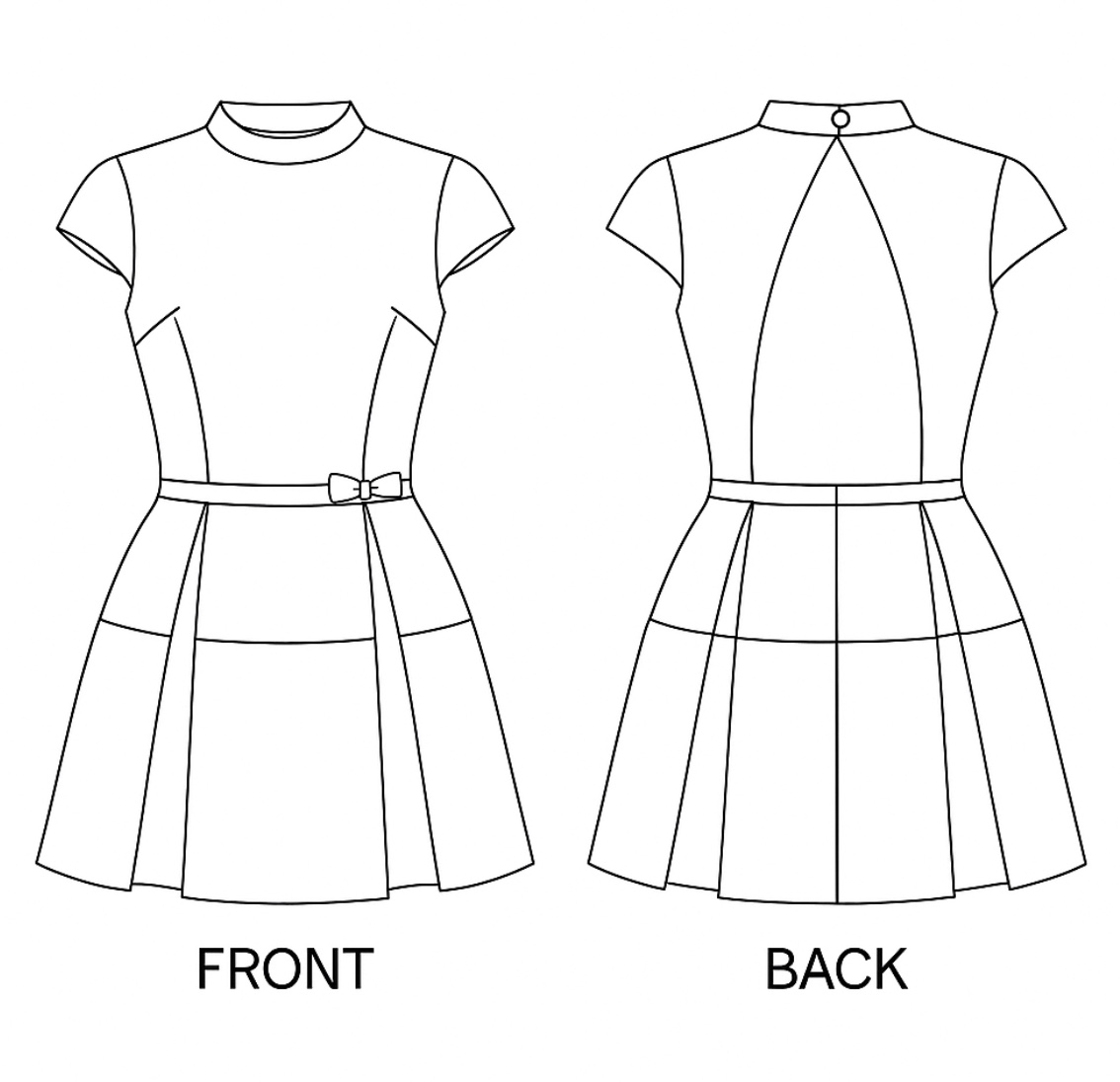
Saida Dress
"A mini dress with cap sleeves, an open back, a turtle neck and a pleated skirt. The dress features a fitted top which is split into a centre front and side panels. The cutlines meet at the bust apex. The first cut line starts at 4cm below the underarm and runs until the bust apex, the second cutline is curved, starting at the bust apex, through the underbust then to the waist. The dress features cap sleeves having endpoints 4 cm to the sides of the underarm. For shaping, the sleeves have a curved dart at the sleeve cap that help contour the shoulder. The dress features a neck band of about 2.5 cm. The back bodice features an open bodice. The front and back have a flared skirt each having inverted box pleats at the top all the way to the bottom. The front skirt features a single box pleat aligned with the upper vertical cut seam and the back has two inverted pleats."
Technical mini dress with precise measurements, detailed construction including cutline specifications, sleeve engineering, and pleat alignment.

Open Neckline Dress with Curved Darts and Cutout Skirt
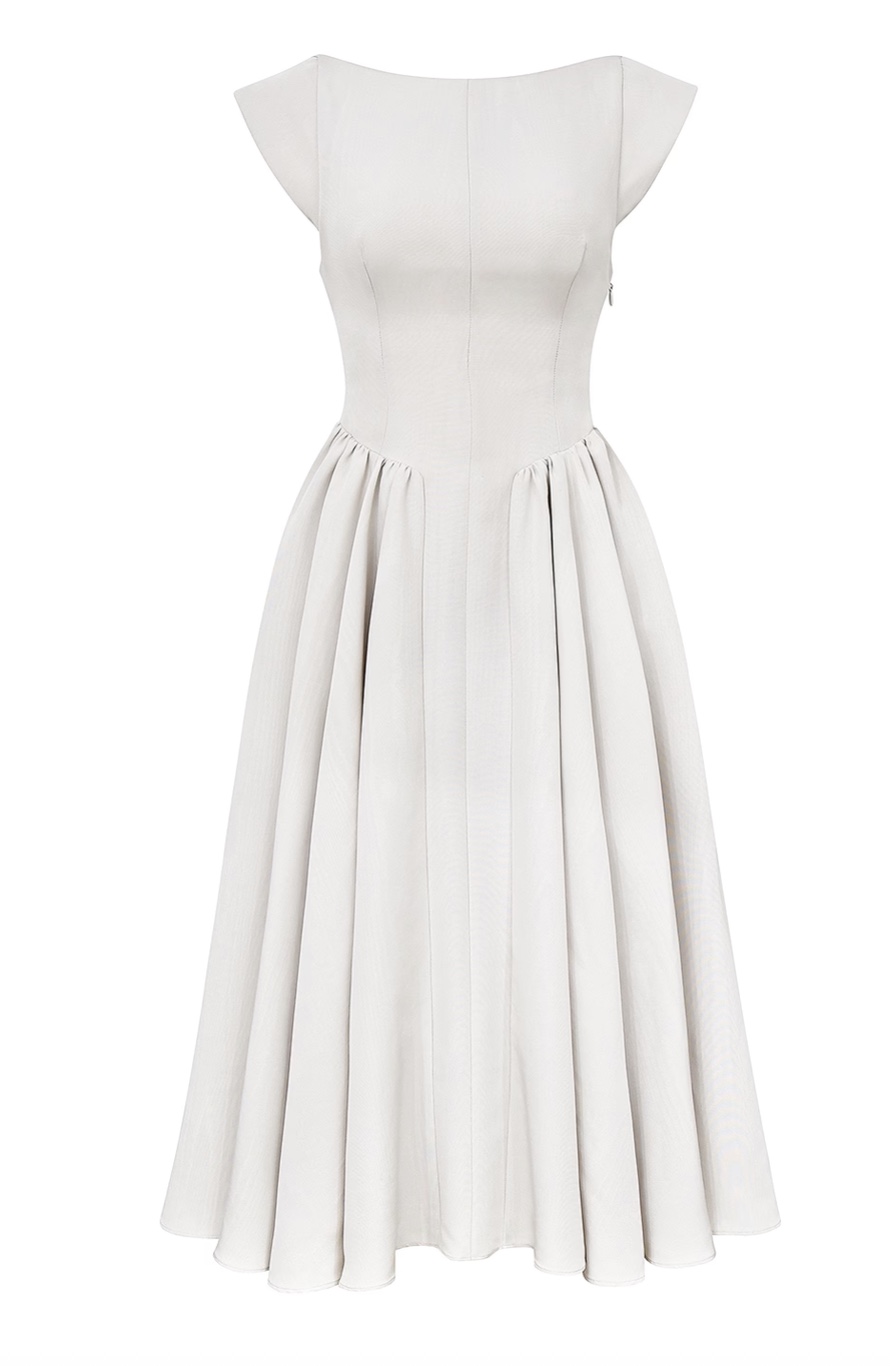
Debutante Dress
"A calf-level dress with flared bottom, a bateau neckline and short cap sleeves. The dress features two side skirt panels inserted at the sides to add volume to the dress. The inserted skirt features a top curve starting 5cm away from the centre front and at the hip level and curving up to meet the side seam at 4cm below the waist level, continuing to the back at the same level to form a back skirt. The curve is delimited by a straight vertical seam at the front running to the dresses' hem. The side skirt upper curve is gathered to provide volume and the entire hem curve is flared. The front features only 3 panels: 1 center front panel, two side skirts. The back features two centre back panels split in the middle by the center back seam for zipper insertion, a full gathered skirt. The side skirts from the front and back are merged together. The front features a curved dart starting at the bust apex, through the underbust, the waist and stopping at the inserted skirt curved hem at 4cm after it starts. The dress features a 2cm shoulder line and an open boat neckline. The sleeves are cap sleeves featuring only a sleeve cap and a sleeve hem. The sleeve cap is similar to the armhole shape only starting 4cm to the left and right of the bottom armhole. The back of the dress features an open back, with a circular cutout starting at 3cm below the back neck, going to the mid shoulder level and turning down to the bottom of the shoulder blade to curve back again at the center back."
Sophisticated calf-length dress with detailed panel construction, precise measurements for skirt insertion, dart placement, and complex back cutout specifications.

Pro Tips

📐

Include Measurements

Specify precise measurements like "4cm below the underarm" or "2.5cm neck band" for accurate construction.

✂️

Describe Construction

Detail how panels connect, where cutlines meet, and how seams align for proper garment engineering.

🎯

Specify Shaping Elements

Include details about darts, pleats, and other shaping techniques that affect the garment's fit and drape.

🔗

Connect Elements

Explain how different parts relate to each other, like how pleats align with seams or how sleeves connect to the bodice.

Common Mistakes to Avoid

Missing Measurements

"Cap sleeves" → "Cap sleeves having endpoints 4 cm to the sides of the underarm"

Unclear Construction

Avoid vague descriptions like "fitted top" without explaining how it's constructed or where seams are placed.

Inconsistent Alignment

Ensure all design elements align properly - pleats should align with seams, cutlines should meet at logical points.

Ready to Create?

Put your prompt skills to the test and generate your first design!