Art and mathematics were never separate.
Old masters techniques have evolved into powerful computer graphic engines.
I almost quit school to become a full-time artist. Instead, I became a mathematician. To most people, this sounds like I gave up on art. They usually assume I took the opposite path. For me, it never felt that way.
Here's a snapshot of what happens almost daily in the brain of a mathematician/artist:
I was taking a figurative drawing class, and the session was an anatomical study using the "egg-shape" technique. The instructor told us to draw the human body using only simple oval forms. While I was drawing and building the body's anatomy out of these ovals, I suddenly started thinking: what if we actually used this technique in computer graphics?
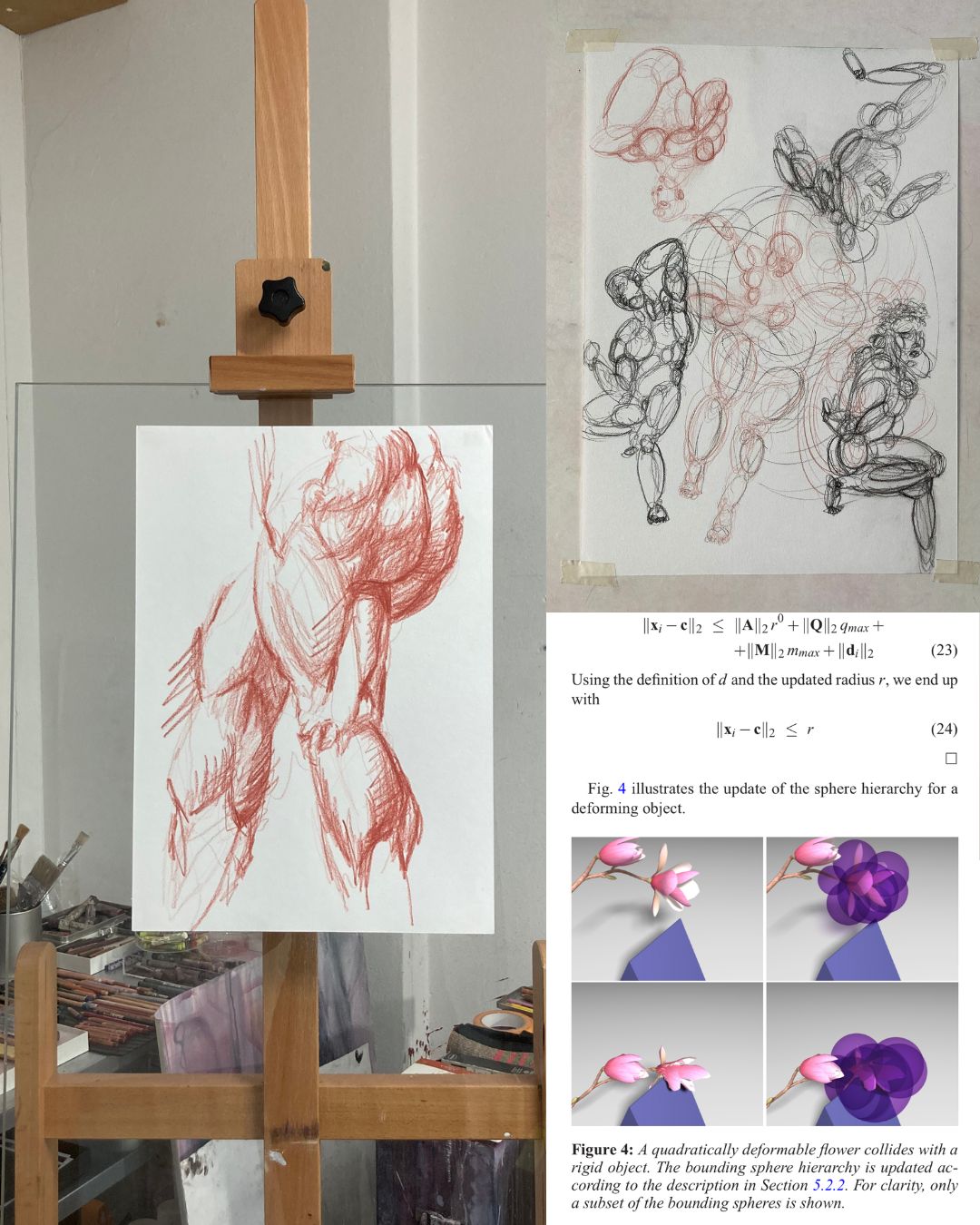
Left: Anatomical study using the egg-shape technique from a figurative drawing class. Right: The research paper on bounding sphere hierarchies that formalized the same intuition for cloth–body collision detection.
At the time, I was working on cloth–body collisions for LA VIPÈRE's simulator. Classically, you would use bounding volumes, usually bounding boxes, to reduce complexity and only look for collisions at a small subset of areas.
I kept asking myself: what if instead of approximating the body with standard bounding boxes, we used a set of spheres? Balls approximate organic forms much better, and collision detection becomes simpler and more efficient. Immediately, I started running the math in my head. What's less complex: boxes or balls?
Custom Solutions over Off-the-Shelf
In computer graphics, bounding boxes are the most general solution. They work for all kinds of objects, which is why they're widely used. But my case wasn't general. I had one human avatar and one garment, and I wanted to optimize that specific interaction. This is exactly the kind of situation where choosing between off-the-shelf solutions and custom solutions makes the difference. I was not interested in any collision, I was interested in the collision of a human body with a cloth.
At that moment, the inspiration came straight from intuition and drawing, not from staring at equations in papers. Granted, immediately as I came home, I started looking for papers that already explored this concept. And that's when mathematics takes place, when you start comparing complexities and speed gains.
Where Art and Mathematics Intersect
For me, this is one of many examples of how art, mathematics, and engineering constantly intersect. We're all living in the same world, and that world follows the same laws. Artists, mathematicians, engineers and physicists all try to approximate it and come up with laws and rules to reduce its complexity, from perspective systems, to 40 layers of paint for realistic rendering, to formal systems and equations.
What I find beautiful is being at that intersection, being able to speak both languages, the artistic one and the mathematical one, and to move between them. To discover new connections instead of repeating the same ideas of those who came before me.
That's the path I find the most exciting and I'm more than privileged to have these moments while building the algorithms at LA VIPÈRE.